
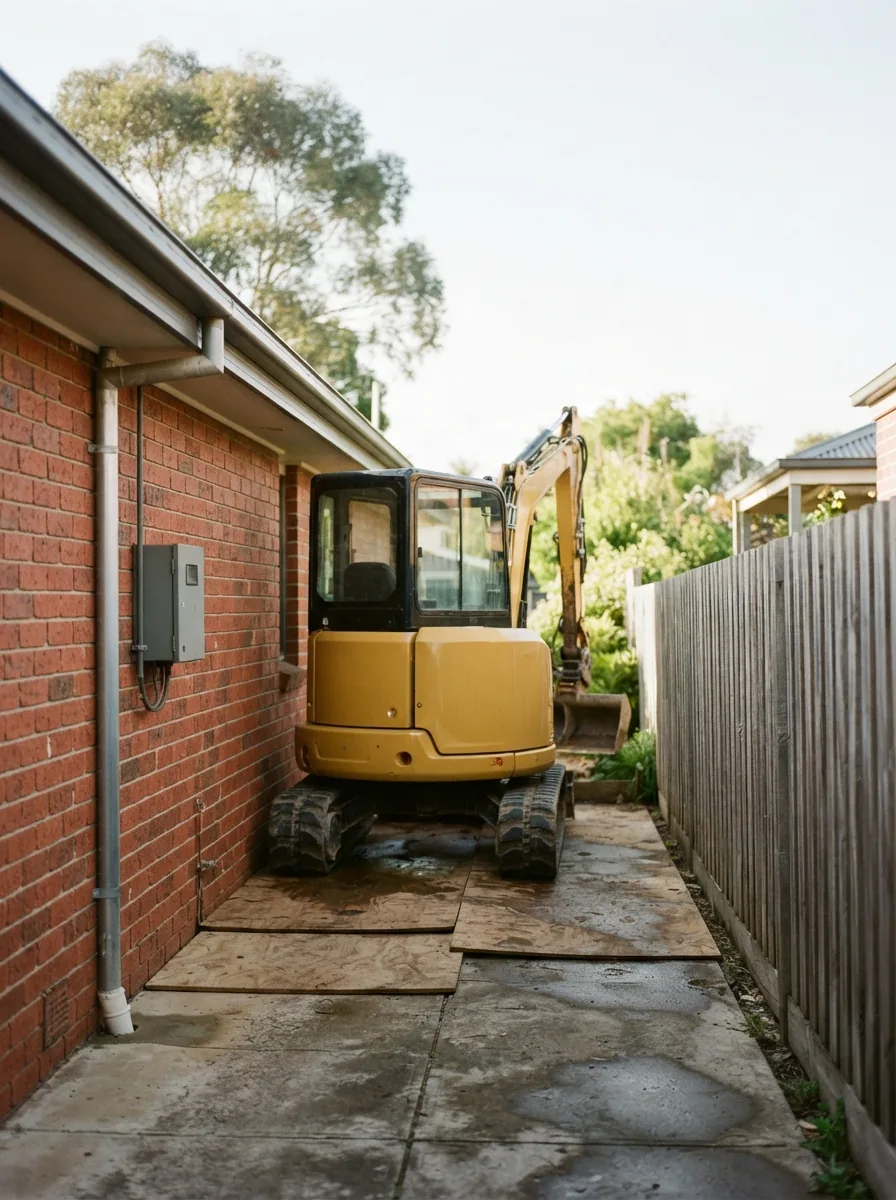
Tight Access Excavation in Sydney, NSW
What is included
What Is Included in Our Tight Access Excavation
- We measure the narrowest point of the side passage, including gate posts, downpipes, meter boxes and eaves.
- We get the underground service plans, because side passages often carry the gas, water and sewer lines.
- Boards or mats go down over pavers, turf and concrete paths along the route the machine travels.
- The mini excavator walks in through the passage, and a fence panel comes out only if agreed.
- Spoil is carted back out along the same route and loaded onto the tipper at the kerb.
- We dig around trees, retaining walls and neighbouring footings slowly, watching for roots and anything unexpected.
- The machine walks out the way it came, the boards come up and the passage is swept.
- We walk the route with you at handover and point out any mark on paths or fences.
Why us
Why Choose Us for Tight Access Excavation?
Accountable for every job, long after the day
Every tight access excavation job is done by the people who will still be here next year.
Tested and signed off before we leave
Everything we touch on your tight access excavation is tested before we go, you get walked through exactly what was done.
Local excavation contractors, not a call centre
An excavation contractor answers the phone and the same faces come back if the job runs over a day.
How the job runs
Why the tape measure comes before the machine
Measure the narrowest point
On the first call we ask for the width of the narrowest point, from post to post or wall to fence, and whether there are steps or a slope. We also ask what is being dug and how much. Those answers decide whether the machine fits, and how the spoil gets out to the street.
A quote priced on access
Tight access jobs take longer per cubic metre because every load travels the length of the passage. The written quote states the access route, what is protected, and how spoil leaves the site. If a fence panel or gate has to come off, that is written in, so nobody is surprised on the day.
In and out the same way
We lay the boards first, then walk the mini excavator in. Spoil goes out to the tipper at the kerb as we dig, so it never piles up against your house. When the dig is finished we take the boards up, sweep the passage and walk the route with you.
Common questions
Frequently Asked Questions
What size jobs do you take on?
Small residential jobs through to larger civil and infrastructure work. A single trench across a front lawn, a set of footings for an extension, a bulk cut for a new slab and the underground services for a commercial site are all jobs we do.
Can your machine get into a narrow side passage?
Usually, yes. A mini excavator fits through most gates and side passages that a larger machine cannot. Send a photo of the narrowest point with a tape measure across it, and we will tell you whether the machine fits or whether that part has to be dug by hand.
Do you connect the power, water or sewer once the trench is dug?
No. We do the civil side: digging the trench to depth, bedding, laying the conduit or pipe, installing pits, backfilling and reinstating. The connection, testing and sign-off are done by an electrician or a plumber, and we work around their timing.
What is non-destructive digging, and when do I need it?
It means opening the ground with water and vacuum, or by hand, instead of a bucket. It is used where cables, gas lines or water mains are close to the dig, so they can be found and exposed without being damaged.
Do you take the spoil away?
Where the job calls for it, yes. Spoil is loaded into a tipper and taken off site. Where it can be reused on the block for backfill or levelling, we talk about that with you first, because it changes how much leaves the site.
What if you hit rock or old fill?
How deep the rock sits, and whether there is buried rubble or old fill, only shows once the bucket is in the ground. If we find something that changes the job, we stop and tell you before the work carries on.
Do you check for underground services before digging?
Every time. We get the underground service plans for the site before we dig, through Before You Dig Australia, and anything close to the line is exposed by hand or vacuum before a machine works near it.
Do you do strip outs and demolition?
Yes, including bathroom strip outs and wider internal strip outs. If old sheeting or materials might contain asbestos, they have to be tested before anything is broken. If that is the case, we stop and tell you, because we do not remove asbestos.
Can you level a yard and lay turf?
Yes. Landscaping covers clearing, levelling and grading the ground so water runs away from the house, building up garden beds and edges, and laying turf once the ground is ready.
Do you need the engineer's plans?
For footings, slab cuts and bulk excavation, yes. The engineer's plans set the depth, width and position of what we dig. For a trench or a landscaping job, a site plan or a few photos are usually enough.
Can I call you outside business hours?
Yes. We answer the phone at any hour, every day. If a trench has collapsed or a pipe has been hit, tell us the suburb and what has happened, and keep people back from the edge until we talk.
Which areas do you cover?
We travel across Sydney, from the CBD and inner south to Parramatta, Western Sydney, the south-west, and St George and Sutherland. If your suburb is not on our list, ask anyway.
Related work
Other jobs we get called out for
bulk excavation and earthmoving
Removing large volumes of soil and rock for building pads, lowered yards and new levels, with the spoil classified, loaded and carted away. For builders and owners across Sydney.
Read moresite preparation and site cuts
Clearing, stripping and cutting a sloping block down to a level platform for a new house, granny flat or extension, set out to the builder's pegs. For homeowners and builders in Sydney.
Read morefooting and foundation excavation
Strip and pad footings dug to the engineer's plan, taken down to the founding material and left clean for inspection, for new homes, extensions, walls and decks across Sydney.
Read moreServing Sydney and The Surrounding Areas
Where we work
Ready when you are
Book Tight Access Excavation in Sydney Today
Send us a photo of the side passage at its narrowest point with a tape measure stretched across it. Text it to the mobile or email it, with a second photo of the area to be dug. From those two pictures we can tell you whether the machine fits.
0485 057 31224 hours a day, 7 days a week
Not urgent? Send us the job instead