
Excavation contractor in Botany, NSW
Digging in Botany's sand and shallow groundwater
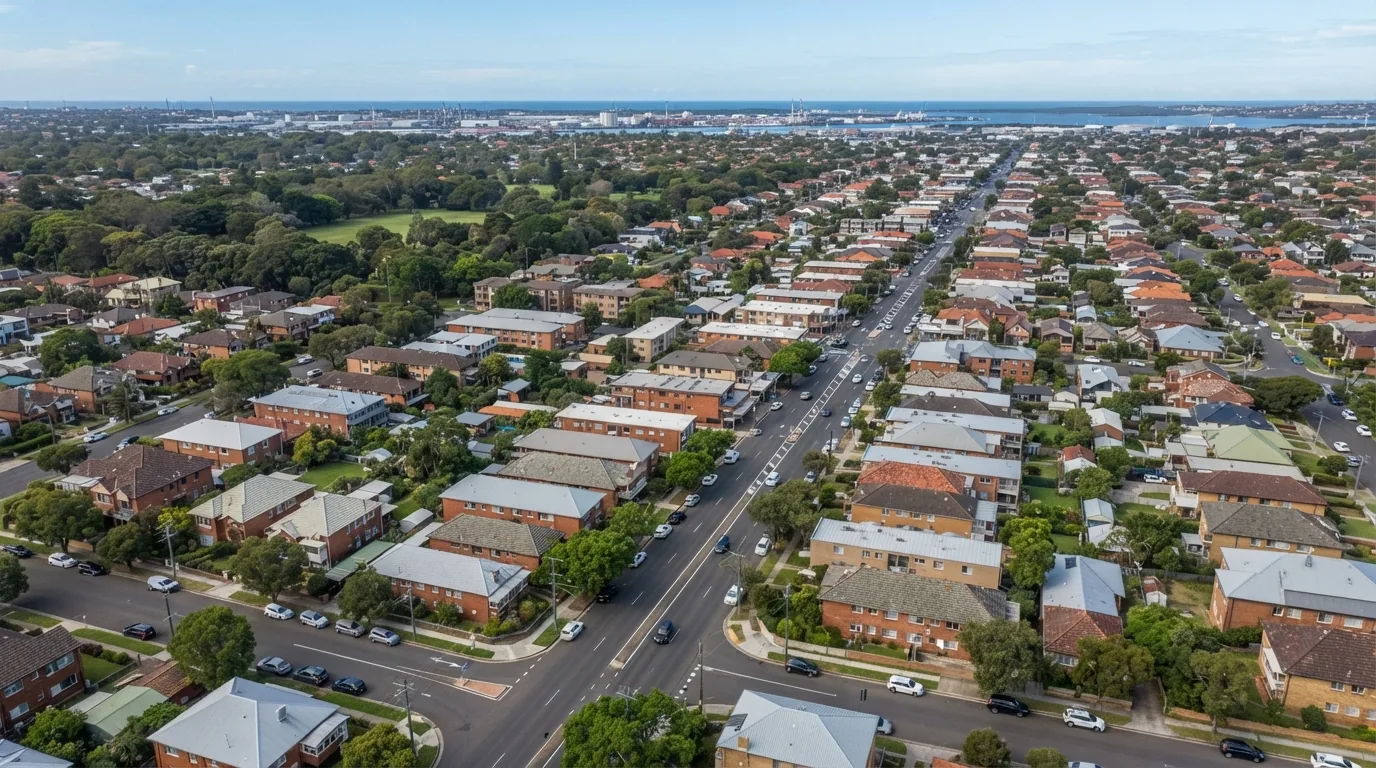
Botany's older streets follow a grid of long, narrow lots laid out when the area was a fishing village on the bay, and over the following decades those lots filled with small detached cottages. Many now carry rebuilt homes, duplexes and low unit blocks. To the east, Banksmeadow and the land toward Port Botany are almost all industrial, with warehouses, depots and container yards. Our work here splits between backyard jobs in the residential grid and service and drainage work on those industrial sites.
Narrow lots mean narrow side passages, so a mini excavator only goes down the side of the house when the gap between wall and fence allows it, and otherwise the digging is done by hand. On most residential streets a tipper can park out front. On industrial sites the challenge is the traffic around us: container trucks, forklifts and site rules that need an induction before anyone starts work. Trenches across a working yard are opened in sections so the yard keeps moving.
Under all of Botany is the Botany Sands aquifer, and NSW government sources put the water table often less than one to two metres below the surface. A footing hole, a pit or a pool excavation can reach water quickly. Taking water from this aquifer is restricted by the state, and parts of it carry contamination left by old tanneries, wool scourers and other industry, so water pumped from a hole cannot simply go down the gutter. The sand digs easily but runs when wet, so trench walls need shoring or a wide batter.
What we do here most
What Botany keeps needing
Almost every job here is shaped by the water in the sand, either by meeting it sooner than expected or by keeping a trench open long enough to finish.
Sewer & Water Service Trenching
Relaying a cottage sewer line through wet sand
Older cottages often still run their sewer in clay pipe under the backyard. When it is replaced, the trench can reach groundwater before it reaches the depth the pipe needs. We dig in short runs, keep the walls supported, and lay the pipe on bedding to the grade the plumber sets. The plumber makes the connection, and we backfill each section before opening the next.
Site Preparation & Site Cuts
Preparing a narrow lot for a new home
A knockdown on one of Botany's narrow lots leaves old footings, broken slab and fill to clear before the new build. Sites here are mostly flat, so the cut is shallow, but the sand underneath needs compacting in layers before a slab goes down. Old fill is checked for anything that looks like contamination before it leaves. We set the pad to the levels on the builder's plans.
Backfilling, Compaction & Site Reinstatement
Compacting sand back so the path does not sink
Sand that goes back into a trench loose will settle for months, and paths and driveways crack along the line. We place the backfill in thin layers, compact each one with the plate compactor, and dampen dry sand so it packs tight. Where the trench went below the water table, the lowest layers go back in straight after the pipe is checked. The surface is then reinstated with turf, pavers or concrete.
Underground Utility Trenching
New services across an industrial yard near the port
Warehouses and depots in Botany and Banksmeadow keep adding services: new water lines, data conduit to a gatehouse, power to a new shed. Trenches across a working yard are cut in sections so trucks and forklifts can still move. Industrial ground here often hides old services and fill under the hardstand, so we get the plans first and expose crossings by hand. The hardstand is reinstated before that section reopens.
If it is urgent
If a trench floods or caves in in Botany
- 1Keep everyone well back from the edge, because wet sand can slump without warning and take the ground at the lip with it.
- 2Do not climb in to rescue tools or pump the water into the street gutter, since groundwater here may be contaminated and has to be dealt with properly.
- 3When you call us, tell us how deep the water is in the hole, whether it is still rising, and whether the site is a house lot or an industrial yard.
Common questions
Frequently Asked Questions
What size jobs do you take on?
Small residential jobs through to larger civil and infrastructure work. A single trench across a front lawn, a set of footings for an extension, a bulk cut for a new slab and the underground services for a commercial site are all jobs we do.
Can your machine get into a narrow side passage?
Usually, yes. A mini excavator fits through most gates and side passages that a larger machine cannot. Send a photo of the narrowest point with a tape measure across it, and we will tell you whether the machine fits or whether that part has to be dug by hand.
Do you connect the power, water or sewer once the trench is dug?
No. We do the civil side: digging the trench to depth, bedding, laying the conduit or pipe, installing pits, backfilling and reinstating. The connection, testing and sign-off are done by an electrician or a plumber, and we work around their timing.
What is non-destructive digging, and when do I need it?
It means opening the ground with water and vacuum, or by hand, instead of a bucket. It is used where cables, gas lines or water mains are close to the dig, so they can be found and exposed without being damaged.
Do you take the spoil away?
Where the job calls for it, yes. Spoil is loaded into a tipper and taken off site. Where it can be reused on the block for backfill or levelling, we talk about that with you first, because it changes how much leaves the site.
What if you hit rock or old fill?
How deep the rock sits, and whether there is buried rubble or old fill, only shows once the bucket is in the ground. If we find something that changes the job, we stop and tell you before the work carries on.
Do you check for underground services before digging?
Every time. We get the underground service plans for the site before we dig, through Before You Dig Australia, and anything close to the line is exposed by hand or vacuum before a machine works near it.
Do you do strip outs and demolition?
Yes, including bathroom strip outs and wider internal strip outs. If old sheeting or materials might contain asbestos, they have to be tested before anything is broken. If that is the case, we stop and tell you, because we do not remove asbestos.
Can you level a yard and lay turf?
Yes. Landscaping covers clearing, levelling and grading the ground so water runs away from the house, building up garden beds and edges, and laying turf once the ground is ready.
Do you need the engineer's plans?
For footings, slab cuts and bulk excavation, yes. The engineer's plans set the depth, width and position of what we dig. For a trench or a landscaping job, a site plan or a few photos are usually enough.
Can I call you outside business hours?
Yes. We answer the phone at any hour, every day. If a trench has collapsed or a pipe has been hit, tell us the suburb and what has happened, and keep people back from the edge until we talk.
Which areas do you cover?
We travel across Sydney, from the CBD and inner south to Parramatta, Western Sydney, the south-west, and St George and Sutherland. If your suburb is not on our list, ask anyway.
Everything we do here
Services in Botany, NSW
In Botany the list below is planned around the sand and the water table, because together they decide how long a trench can safely stay open.
Local, and on the phone
Planning a dig in Botany
If your builder or engineer has a geotechnical report for the site, send us the page that gives the groundwater depth. In Botany that one number tells us whether the job needs shoring and pumping, and how many short sections it has to be split into.
0485 057 31224 hours a day, 7 days a week
Not urgent? Send us the job instead