
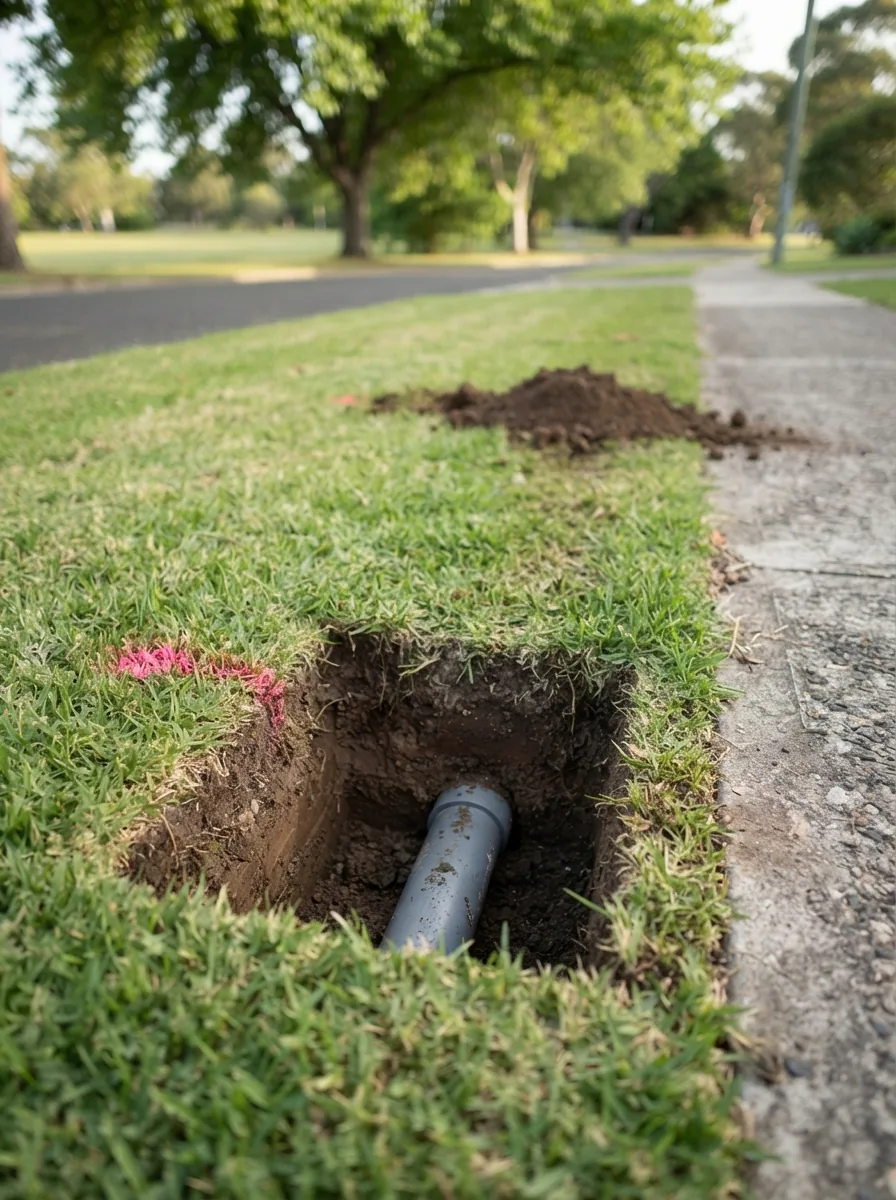
Potholing and Underground Service Exposure in Sydney, NSW
What is included
What Is Included in Our Potholing and Underground Service Exposure
- Working from the service plans, we mark each pothole point along the route with you.
- Points go where the plans are least certain: bends, crossings, and either side of the new work.
- Each pothole is dug with water or air and suction, just wide enough to see the service.
- We dig until the top of the service shows, then clear its sides to see its size and type.
- Depth is measured from the finished surface to the top of the service, and the spot is paint marked.
- Each pothole is photographed with the measurement recorded and a fixed reference point in frame.
- Holes are backfilled and compacted, or plated and left open if the surveyor still needs them.
- At handover you get a table of every pothole: location, service found, depth, and its photo.
Why us
Why Choose Us for Potholing and Underground Service Exposure?
Accountable for every job, long after the day
Every potholing and underground service exposure job is done by the people who will still be here next year.
Tested and signed off before we leave
Everything we touch on your potholing and underground service exposure is tested before we go, you get walked through exactly what was done.
Local excavation contractors, not a call centre
An excavation contractor answers the phone and the same faces come back if the job runs over a day.
How the job runs
Why the plans need checking in the ground
Which service, which route
On the first call we ask which service you need found and what is going in near it: a driveway, a footing, a bore or a new trench. We ask whether you have the service plans and a design drawing. From that we work out roughly how many potholes the route needs, and where they should go.
Quoted pothole by pothole
The written quote lists each pothole, its expected depth, and what you get afterwards: photos, depths and a marked-up plan. It says whether the holes are filled straight away or left plated for a surveyor. If a service is not where the plans put it, we widen the search and tell you before adding holes.
Measured, photographed, then filled
On the day we dig each point in turn, measure from the surface to the top of the service and mark the spot with paint. Every hole is photographed before it is filled or plated. You get the results as a table with photos that your designer or engineer can work from directly.
Common questions
Frequently Asked Questions
What size jobs do you take on?
Small residential jobs through to larger civil and infrastructure work. A single trench across a front lawn, a set of footings for an extension, a bulk cut for a new slab and the underground services for a commercial site are all jobs we do.
Can your machine get into a narrow side passage?
Usually, yes. A mini excavator fits through most gates and side passages that a larger machine cannot. Send a photo of the narrowest point with a tape measure across it, and we will tell you whether the machine fits or whether that part has to be dug by hand.
Do you connect the power, water or sewer once the trench is dug?
No. We do the civil side: digging the trench to depth, bedding, laying the conduit or pipe, installing pits, backfilling and reinstating. The connection, testing and sign-off are done by an electrician or a plumber, and we work around their timing.
What is non-destructive digging, and when do I need it?
It means opening the ground with water and vacuum, or by hand, instead of a bucket. It is used where cables, gas lines or water mains are close to the dig, so they can be found and exposed without being damaged.
Do you take the spoil away?
Where the job calls for it, yes. Spoil is loaded into a tipper and taken off site. Where it can be reused on the block for backfill or levelling, we talk about that with you first, because it changes how much leaves the site.
What if you hit rock or old fill?
How deep the rock sits, and whether there is buried rubble or old fill, only shows once the bucket is in the ground. If we find something that changes the job, we stop and tell you before the work carries on.
Do you check for underground services before digging?
Every time. We get the underground service plans for the site before we dig, through Before You Dig Australia, and anything close to the line is exposed by hand or vacuum before a machine works near it.
Do you do strip outs and demolition?
Yes, including bathroom strip outs and wider internal strip outs. If old sheeting or materials might contain asbestos, they have to be tested before anything is broken. If that is the case, we stop and tell you, because we do not remove asbestos.
Can you level a yard and lay turf?
Yes. Landscaping covers clearing, levelling and grading the ground so water runs away from the house, building up garden beds and edges, and laying turf once the ground is ready.
Do you need the engineer's plans?
For footings, slab cuts and bulk excavation, yes. The engineer's plans set the depth, width and position of what we dig. For a trench or a landscaping job, a site plan or a few photos are usually enough.
Can I call you outside business hours?
Yes. We answer the phone at any hour, every day. If a trench has collapsed or a pipe has been hit, tell us the suburb and what has happened, and keep people back from the edge until we talk.
Which areas do you cover?
We travel across Sydney, from the CBD and inner south to Parramatta, Western Sydney, the south-west, and St George and Sutherland. If your suburb is not on our list, ask anyway.
Related work
Other jobs we get called out for
slot trenching
A narrow slot dug by vacuum along the line of new work, so any unknown cable or pipe crossing it is found before a machine or bore goes in. For Sydney builders and sites.
Read moretrenchless underground boring
For homeowners and builders who need a pipe or conduit under a driveway, path or garden, we push a Grundomat bore through the soil so the surface stays in place.
Read morebackfilling, compaction and site reinstatement
Backfilling trenches and pits in compacted layers, then putting the lawn, garden or paving back, for builders, trades and homeowners after an excavation.
Read moreServing Sydney and The Surrounding Areas
Where we work
Ready when you are
Book Potholing and Underground Service Exposure in Sydney Today
Send us the design drawing or site plan with the new work drawn on it. A photo of a printed copy is fine. Text it to the mobile or email it, and we mark up the pothole points from there.
0485 057 31224 hours a day, 7 days a week
Not urgent? Send us the job instead