
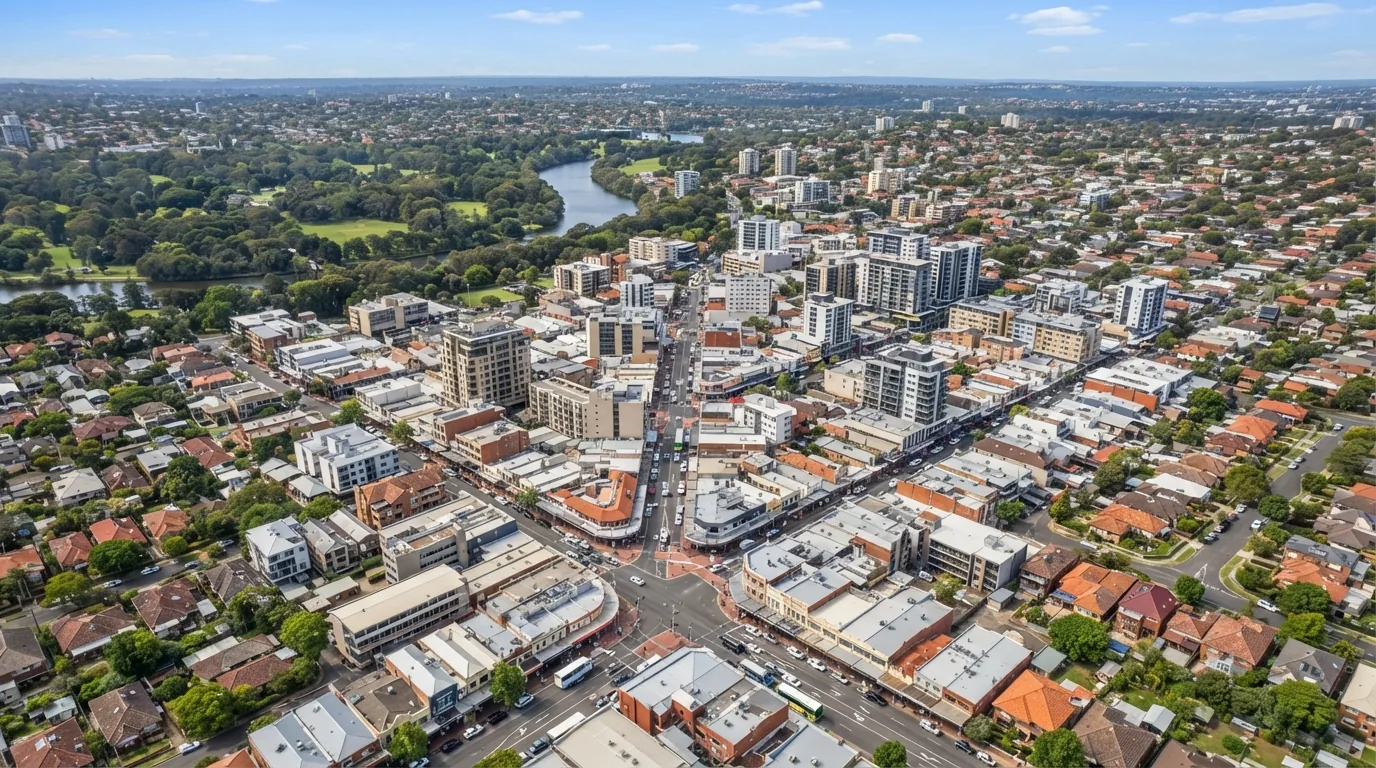
Excavation contractor in Parramatta, NSW
Digging beside the river in Parramatta
Parramatta is now mostly apartments. At the 2021 census about 85 per cent of homes in the suburb were flats or units, and fewer than one in ten were separate houses. So the work here is less about back yards and more about the ground around buildings: service trenches for strata blocks, drainage repairs in shared courtyards, pits and conduit for commercial fitouts, and planting beds around new towers. A few older houses remain, and Parramatta Park and Old Government House sit right beside the centre.
Access is the first planning question in Parramatta. Many sites front busy city streets where kerb space is scarce, loading zones are shared and a tipper cannot simply park across a footpath. The light rail opened through the centre in December 2024, and work close to its tracks and overhead wires is planned with whoever controls that land before we start. For strata blocks we often reach a courtyard through a basement ramp or a pedestrian gate, so the width of that gap decides which machine fits, and spoil may be carried out in small loads to a tipper waiting at the street.
Near the river, Parramatta sits on an old terrace of sand and silt laid down by floods, known as the Parramatta Sand Body, with weathered shale clay on the rising ground behind it. That sand has given up Aboriginal and early colonial artefacts in many city digs, so a development consent here can carry archaeological conditions that must be met before machine digging. Sand trench walls also give way quickly when wet, and the lowest sites near the river can meet water at shallow depth. On top of most of it sits fill from two centuries of building.
What we do here most
What Parramatta keeps needing
Every one of these jobs happens in a small space hemmed in by buildings, underground services and conditions, so most of the work is planning where the machine and the spoil go.
Non-Destructive Digging (NDD)
Exposing services before a city fitout trench
Under a Parramatta footpath or courtyard there can be power, telecommunications, gas, water and old stormwater lines within a metre of each other. Before any trench for a fitout or new connection, we get the service plans and expose each line by non-destructive digging, so its position is seen rather than guessed. Each exposed service is marked and photographed. The trench is then dug with every crossing known.
Tight Access Excavation
Courtyard drainage behind an apartment block
Many apartment blocks here have a landscaped courtyard reached only through a gate or the basement car park. When the drainage under it fails, the mini excavator has to fit through that gap, and the spoil leaves in small loads. We lay boards over paving and lift edges, dig to the failed line and reinstate the courtyard. The strata manager usually needs notice of access times so residents can plan around us.
Landscaping
Planter beds and turf around a new building
New buildings in Parramatta often finish with a landscape plan showing deep planter soil, turf strips and tree pits along the frontage. We dig out builder's rubble and compacted site fill, place the specified soil mix, shape the beds and lay the turf rolls. Where a tree pit sits near services, we expose those services before digging. The beds are watered in before handover.
Footing & Foundation Excavation
Footings for an addition to an older house
Parramatta's remaining older houses sit on sandy ground near the river and on clay further back. An addition needs footings dug to the engineer's depth, often right beside old brick footings that must not be undermined. Where the consent has archaeological conditions, we dig the way those conditions set out and stop when anything old turns up. The engineer inspects the open trench before concrete goes in.
If it is urgent
If a trench gives way or a service is struck in Parramatta
- 1Close off the area with whatever is at hand so residents, shoppers and passers-by stay well back from the open trench.
- 2Do not step into the hole or touch a damaged cable, pipe or conduit, even if it looks dead.
- 3Tell us the address, whether the site is near the light rail line or the river, and whether the building is strata, so we know who else needs to be told.
Common questions
Frequently Asked Questions
What size jobs do you take on?
Small residential jobs through to larger civil and infrastructure work. A single trench across a front lawn, a set of footings for an extension, a bulk cut for a new slab and the underground services for a commercial site are all jobs we do.
Can your machine get into a narrow side passage?
Usually, yes. A mini excavator fits through most gates and side passages that a larger machine cannot. Send a photo of the narrowest point with a tape measure across it, and we will tell you whether the machine fits or whether that part has to be dug by hand.
Do you connect the power, water or sewer once the trench is dug?
No. We do the civil side: digging the trench to depth, bedding, laying the conduit or pipe, installing pits, backfilling and reinstating. The connection, testing and sign-off are done by an electrician or a plumber, and we work around their timing.
What is non-destructive digging, and when do I need it?
It means opening the ground with water and vacuum, or by hand, instead of a bucket. It is used where cables, gas lines or water mains are close to the dig, so they can be found and exposed without being damaged.
Do you take the spoil away?
Where the job calls for it, yes. Spoil is loaded into a tipper and taken off site. Where it can be reused on the block for backfill or levelling, we talk about that with you first, because it changes how much leaves the site.
What if you hit rock or old fill?
How deep the rock sits, and whether there is buried rubble or old fill, only shows once the bucket is in the ground. If we find something that changes the job, we stop and tell you before the work carries on.
Do you check for underground services before digging?
Every time. We get the underground service plans for the site before we dig, through Before You Dig Australia, and anything close to the line is exposed by hand or vacuum before a machine works near it.
Do you do strip outs and demolition?
Yes, including bathroom strip outs and wider internal strip outs. If old sheeting or materials might contain asbestos, they have to be tested before anything is broken. If that is the case, we stop and tell you, because we do not remove asbestos.
Can you level a yard and lay turf?
Yes. Landscaping covers clearing, levelling and grading the ground so water runs away from the house, building up garden beds and edges, and laying turf once the ground is ready.
Do you need the engineer's plans?
For footings, slab cuts and bulk excavation, yes. The engineer's plans set the depth, width and position of what we dig. For a trench or a landscaping job, a site plan or a few photos are usually enough.
Can I call you outside business hours?
Yes. We answer the phone at any hour, every day. If a trench has collapsed or a pipe has been hit, tell us the suburb and what has happened, and keep people back from the edge until we talk.
Which areas do you cover?
We travel across Sydney, from the CBD and inner south to Parramatta, Western Sydney, the south-west, and St George and Sutherland. If your suburb is not on our list, ask anyway.
Everything we do here
Services in Parramatta, NSW
The services below are the ones Parramatta's tight sites, crowded underground services, sandy river ground and archaeological conditions call for most.
Also nearby
We work in these suburbs too
Local, and on the phone
Planning a dig in Parramatta
Send us photos of the route a machine would take from the street to the spot to be dug, with a tape measure across the narrowest point. On Parramatta sites the gate, the ramp or the courtyard door decides the whole plan. If your consent has archaeological conditions, send that page as well.
0485 057 31224 hours a day, 7 days a week
Not urgent? Send us the job instead