
Excavation contractor in Blacktown, NSW
Blacktown's clay, from the station to the back fence
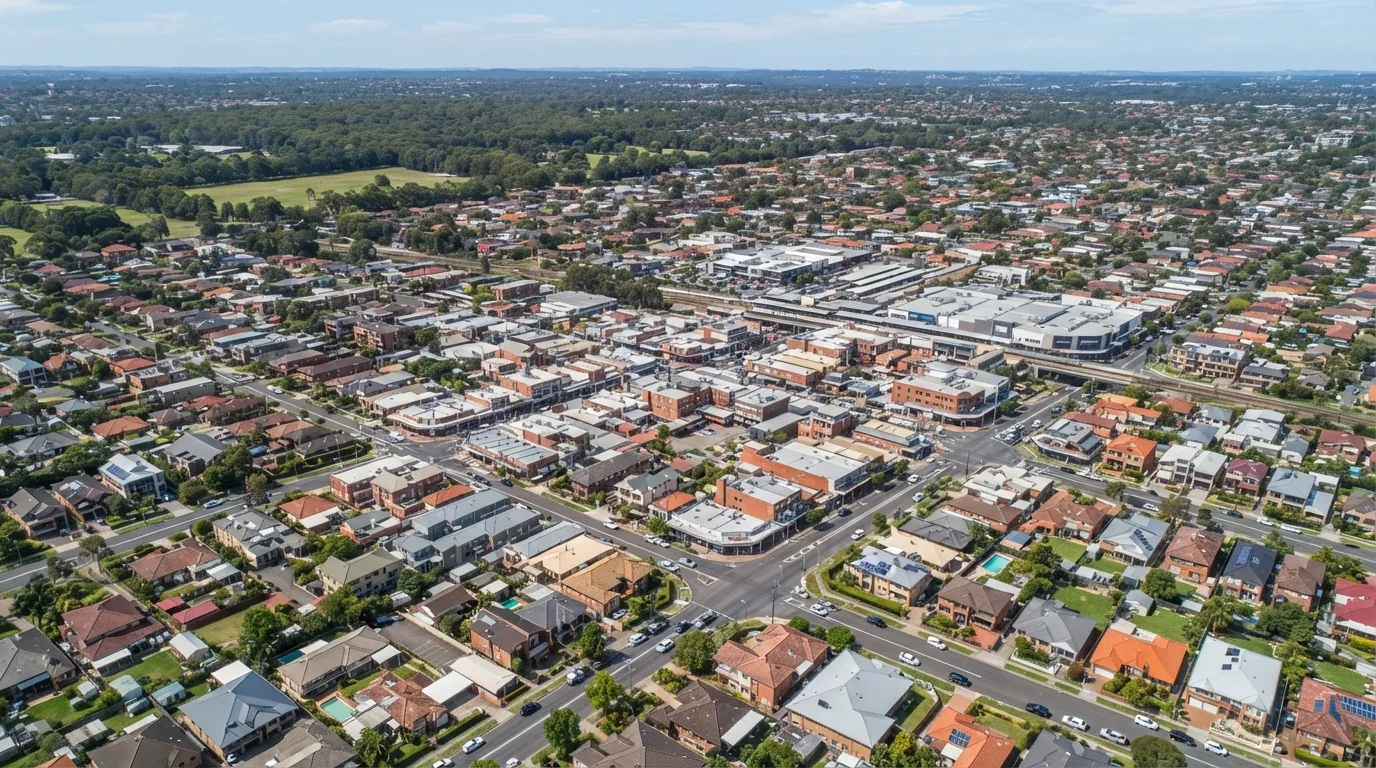
Blacktown spreads out from the station and the CBD, where Westpoint, the hospital and the council offices sit, into residential streets on every side. Around the station, older houses are giving way to apartment towers under the council's high-density zoning. Further out, most blocks hold a single house, and many now share the land with a granny flat or a duplex. The industrial streets around Bessemer Street, close to the T-way, are the other part of our Blacktown work.
Around the CBD, kerbside parking is short-stay and busy, and tower sites take up lanes with cranes and hoardings, so a tipper needs a planned place to stop. In the residential streets most houses have a driveway down one side with a carport or garage at the end, and the back of the block is reached past it. Where a granny flat is going in out the back, the mini excavator walks down the driveway and the spoil comes back to the street by mini loader. The Bessemer Street yards take a truck without trouble.
Blacktown gives its name to the Blacktown soil landscape, mapped across the Cumberland Plain: gentle rises on Wianamatta shale, with a highly plastic, reactive clay subsoil that drains poorly. That clay swells and shrinks with the seasons, which is why engineers specify deeper footings and piers here, and why water collects against slab edges after rain. Many houses date from the postwar growth of the 1950s to 1970s and may have fibro sheeting inside or out. It is tested for asbestos before it is cut or broken.
What we do here most
What Blacktown's postwar blocks keep needing
Most Blacktown work comes from one change: houses from the postwar decades being renovated, or sharing their block with a second dwelling, on clay that moves.
Bathroom strip outs
Stripping a postwar bathroom lined with fibro
Bathrooms in Blacktown houses from the 1950s to 1970s were often lined with fibro sheeting behind the tiles. Before anything is broken, the sheeting is sampled and tested, and if it may contain asbestos we stop and tell you. Once it is cleared, and the plumber has capped the water and waste, we remove the tiles, fixtures, screed and wall linings and leave the room ready for the builder.
Footing & Foundation Excavation
Pier holes for a granny flat on reactive clay
Engineers working on Blacktown clay often specify piers or deepened edge beams so a new granny flat or duplex does not move with the seasons. We dig to the depths on the engineer's footing plan and keep the holes clean and dry until the inspection. The clay can stay stiff for metres or reach shale sooner than the plan expects, and you hear about either as soon as we find it.
Plumbing & Drainage Trenching
Taking ponding water away from slab edges
Because the clay here drains slowly, water ponds against Blacktown houses and soaks under the slab edge. We trench a subsoil drain along the wall, bed a slotted pipe in gravel wrapped in filter fabric, and lay it to fall to a pit. The trench is kept clear of the footings so the drain does not undermine what it protects. The plumber connects the pit to the stormwater system.
Underground Utility Trenching
Service trenches to a granny flat out the back
A granny flat at the back of a Blacktown block needs water, sewer, power and data run from the main house or the street, usually along the driveway. We get the service plans, trench each line to its depth and separation, lay pipe and conduit in bedding sand, and backfill in compacted layers. The driveway edge and lawn are put back. The plumber and the electrician make their connections.
If it is urgent
If a trench collapses or a service is hit in Blacktown
- 1Keep everyone away from the trench, and turn off the water at the meter if a pipe has burst.
- 2Do not climb into the trench, and do not touch an exposed cable or pick up any broken fibro sheeting.
- 3When you call, tell us the street, whether the house is near the CBD or further out, and whether it has rained, because this clay loses strength when it is wet.
Common questions
Frequently Asked Questions
What size jobs do you take on?
Small residential jobs through to larger civil and infrastructure work. A single trench across a front lawn, a set of footings for an extension, a bulk cut for a new slab and the underground services for a commercial site are all jobs we do.
Can your machine get into a narrow side passage?
Usually, yes. A mini excavator fits through most gates and side passages that a larger machine cannot. Send a photo of the narrowest point with a tape measure across it, and we will tell you whether the machine fits or whether that part has to be dug by hand.
Do you connect the power, water or sewer once the trench is dug?
No. We do the civil side: digging the trench to depth, bedding, laying the conduit or pipe, installing pits, backfilling and reinstating. The connection, testing and sign-off are done by an electrician or a plumber, and we work around their timing.
What is non-destructive digging, and when do I need it?
It means opening the ground with water and vacuum, or by hand, instead of a bucket. It is used where cables, gas lines or water mains are close to the dig, so they can be found and exposed without being damaged.
Do you take the spoil away?
Where the job calls for it, yes. Spoil is loaded into a tipper and taken off site. Where it can be reused on the block for backfill or levelling, we talk about that with you first, because it changes how much leaves the site.
What if you hit rock or old fill?
How deep the rock sits, and whether there is buried rubble or old fill, only shows once the bucket is in the ground. If we find something that changes the job, we stop and tell you before the work carries on.
Do you check for underground services before digging?
Every time. We get the underground service plans for the site before we dig, through Before You Dig Australia, and anything close to the line is exposed by hand or vacuum before a machine works near it.
Do you do strip outs and demolition?
Yes, including bathroom strip outs and wider internal strip outs. If old sheeting or materials might contain asbestos, they have to be tested before anything is broken. If that is the case, we stop and tell you, because we do not remove asbestos.
Can you level a yard and lay turf?
Yes. Landscaping covers clearing, levelling and grading the ground so water runs away from the house, building up garden beds and edges, and laying turf once the ground is ready.
Do you need the engineer's plans?
For footings, slab cuts and bulk excavation, yes. The engineer's plans set the depth, width and position of what we dig. For a trench or a landscaping job, a site plan or a few photos are usually enough.
Can I call you outside business hours?
Yes. We answer the phone at any hour, every day. If a trench has collapsed or a pipe has been hit, tell us the suburb and what has happened, and keep people back from the edge until we talk.
Which areas do you cover?
We travel across Sydney, from the CBD and inner south to Parramatta, Western Sydney, the south-west, and St George and Sutherland. If your suburb is not on our list, ask anyway.
Everything we do here
Services in Blacktown, NSW
Each of these services is planned here for reactive clay, slow drainage and the age of the house already on the block.
Also nearby
We work in these suburbs too
Local, and on the phone
Planning your Blacktown granny flat or renovation
Send us the engineer's footing plan or the soil report for the block. The site classification in it tells us how reactive the clay is and how deep we are going. A photo of the driveway with a tape measure across it helps us plan access.
0485 057 31224 hours a day, 7 days a week
Not urgent? Send us the job instead